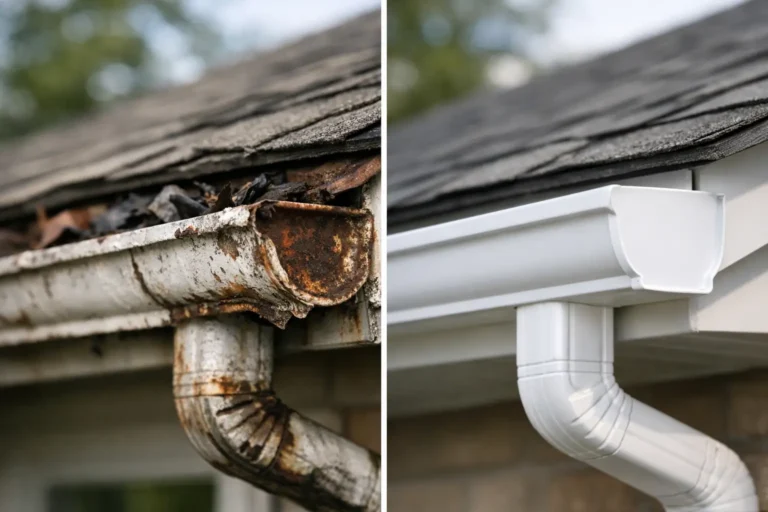
Do Gutter Guards Work With Pine Needles?
If you have pine trees over your roofline, you already know why homeowners ask, do gutter guards work with pine needles? Pine needles are thin, stubborn, and constant. In the Pacific Northwest, they do not show up once in the fall and disappear. They keep dropping through wet months, mix with roof grit and fir debris, and turn a simple gutter system into a maintenance problem fast.
The short answer is yes, gutter guards can work with pine needles. The longer and more honest answer is that some do, some do not, and the difference usually comes down to guard design, installation quality, and the specific conditions around your home.
Do gutter guards work with pine needles in the Pacific Northwest?
They can, but not every product is built for this environment. Pine needles are one of the toughest debris types for a gutter protection system because they are narrow enough to slip through larger openings, light enough to cling to surfaces, and plentiful enough to expose weak points quickly.
That matters even more in places like Vancouver, Camas, Ridgefield, Beaverton, Tigard, Hillsboro, Lake Oswego, and Portland. Our region adds heavy rain to the equation. A guard cannot just block debris. It also has to move a lot of water without overflowing, especially during extended storms.
This is why broad claims like “works on all debris” are not very useful. A gutter guard that performs reasonably well with maple leaves may struggle badly with pine and fir needles. A system that looks good in a showroom may fail once it is installed under evergreen trees and exposed to months of wet weather.
Why pine needles cause so many gutter problems
Pine needles do not behave like large leaves. They mat together, wedge across openings, and often collect at roof edges before washing into the gutter. Once they mix with granules from asphalt shingles, seed pods, and moisture, they create dense clogs that slow drainage and hold water where it should not be.
When gutters clog, the problem is not just the debris sitting in the trough. Water can back up under shingles, spill over the front edge, stain fascia boards, erode landscaping, and saturate the soil around your foundation. In winter, trapped moisture can also add weight and stress to the system.
That is why homeowners looking for a real fix should pay attention to both filtration and structural performance. The guard has to keep debris out, but the gutter system underneath also has to stay properly pitched, securely fastened, and sized for the roof area.
Which gutter guards work best with pine needles?
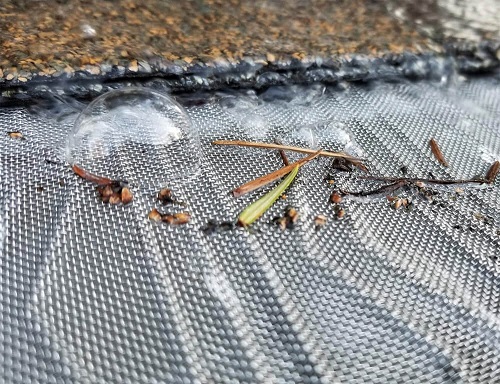
In most pine-heavy environments, fine stainless steel micro-mesh systems tend to perform the best. The reason is simple. The openings are small enough to block pine needles while still allowing water to pass through the mesh and into the gutter below.
Not all mesh products are equal, though. Some lower-grade screens use larger holes, weaker framing, or materials that sag over time. Once a guard bows, separates, or creates gaps at the edges, pine needles will find their way in. That is why the product and the installation need to work together.
Reverse curve and bottle-brush styles are usually less reliable with pine needles. Reverse curve systems may let fine debris enter during heavy flow or allow buildup along the nose of the guard. Brush inserts can catch needles within the bristles, turning the insert itself into the thing that needs cleaning.
Foam inserts are generally a poor long-term choice under evergreen trees. They can trap debris, stay wet, and break down over time. That may be acceptable in a dry climate with lighter debris, but it is rarely a durable answer in the Pacific Northwest.
What makes a gutter guard fail with pine needles?
The failure is often not dramatic at first. It usually starts with small weaknesses. Maybe the openings are just a little too large. Maybe the guard is installed at the wrong angle. Maybe the gutter underneath is already undersized or pulling away from the fascia.
Pine needles expose those weaknesses quickly. If debris can enter through seams, corners, end caps, or lifted sections, it will. If water overshoots the guard in a downpour, you will see overflow at the front edge. If the installer does not account for roof pitch and water speed, even a good product can underperform.
This is one reason professionally installed systems generally outperform off-the-shelf options. The guard is only one part of the system. The gutters, downspouts, hangers, pitch, and roof edge details all affect the result.
The role of installation quality
A good guard on a bad install is still a bad result. That is especially true around pine trees.
The guard should be fitted to the home, not forced into place. It needs to sit securely, maintain proper water capture, and integrate with the existing roofline and gutter profile. Hidden hanger strength matters too, because debris load and water weight can stress weak attachment points over time.
Custom-measured seamless gutters also help. Seams are common trouble spots for leaks and buildup. A seamless system with proper sizing and support gives the guard a better foundation to work from.
For Pacific Northwest homes, it makes sense to look for systems designed for heavy rain and fine evergreen debris, not just general leaf protection. That climate-specific focus is where many homeowners see the difference between fewer cleanings and a system that actually holds up.
What homeowners should realistically expect
A well-designed micro-mesh gutter guard can reduce gutter cleaning dramatically, but it does not mean you will never touch your gutters again. That is not a realistic promise, especially under dense tree cover.
Some debris may still collect on top of the guard and need to be brushed or blown off from time to time. In many cases, wind and rain will move a good portion of that material away on their own. But if your roof is heavily shaded by pine and fir trees, occasional surface maintenance may still be part of the picture.
The big difference is where the debris ends up. With an effective guard, most of it stays out of the gutter channel and away from the downspouts. That means less clogging, less overflow, and far less frequent interior gutter cleaning.
How to tell if a product is right for your home
Start with the trees around the house. A few pines nearby are different from a roofline that sits directly under mature evergreens. Then consider roof pitch, valley placement, rainfall exposure, and the condition of the current gutters.
Ask specific questions, not marketing questions. Will this guard block pine and fir needles? How does it perform in heavy rain? What is the mesh material? Is the frame rigid enough to stay in place for years? Will the installer inspect the gutter pitch, hanger spacing, and downspout capacity before installing anything?
Warranty matters too, but it should not be the only thing you look at. A long manufacturer warranty is valuable when it is paired with sound installation practices and a contractor who is accountable after the job is done.
For many homeowners in Southwest Washington and the Portland metro, that is why owner-led, region-specific service matters. A contractor who works in evergreen conditions every day is more likely to give you a straight answer about what will work on your house and what will not. At NW Gutter Protection, that practical approach is a big part of the value.
So, do gutter guards work with pine needles?
Yes, if you choose the right type and have them installed correctly. No, if you expect any guard at any price point to solve a Pacific Northwest debris problem by itself.
The best results usually come from stainless steel micro-mesh systems paired with solid seamless gutters, proper pitch, strong hidden hangers, and installation tailored to the home. That combination gives you real protection against pine needles, heavy rain, and the overflow issues that lead to larger exterior repairs.
If your current gutters are constantly filling with needles, the right question is not whether gutter guards work in theory. It is whether the system you are considering is built for your trees, your roof, and your weather. That is where a long-term solution starts.