Why Gutters Clog Quickly in the Pacific Northwest
A gutter can look clear from the ground and still be one hard rain away from overflowing. In Southwest Washington and the Portland metro, homeowners often ask why gutters clog quickly even after they were cleaned recently. The short answer is that our wet climate delivers more than water: it carries evergreen needles, moss, roof grit, leaves, and windblown debris into a system that has a limited path to drain.
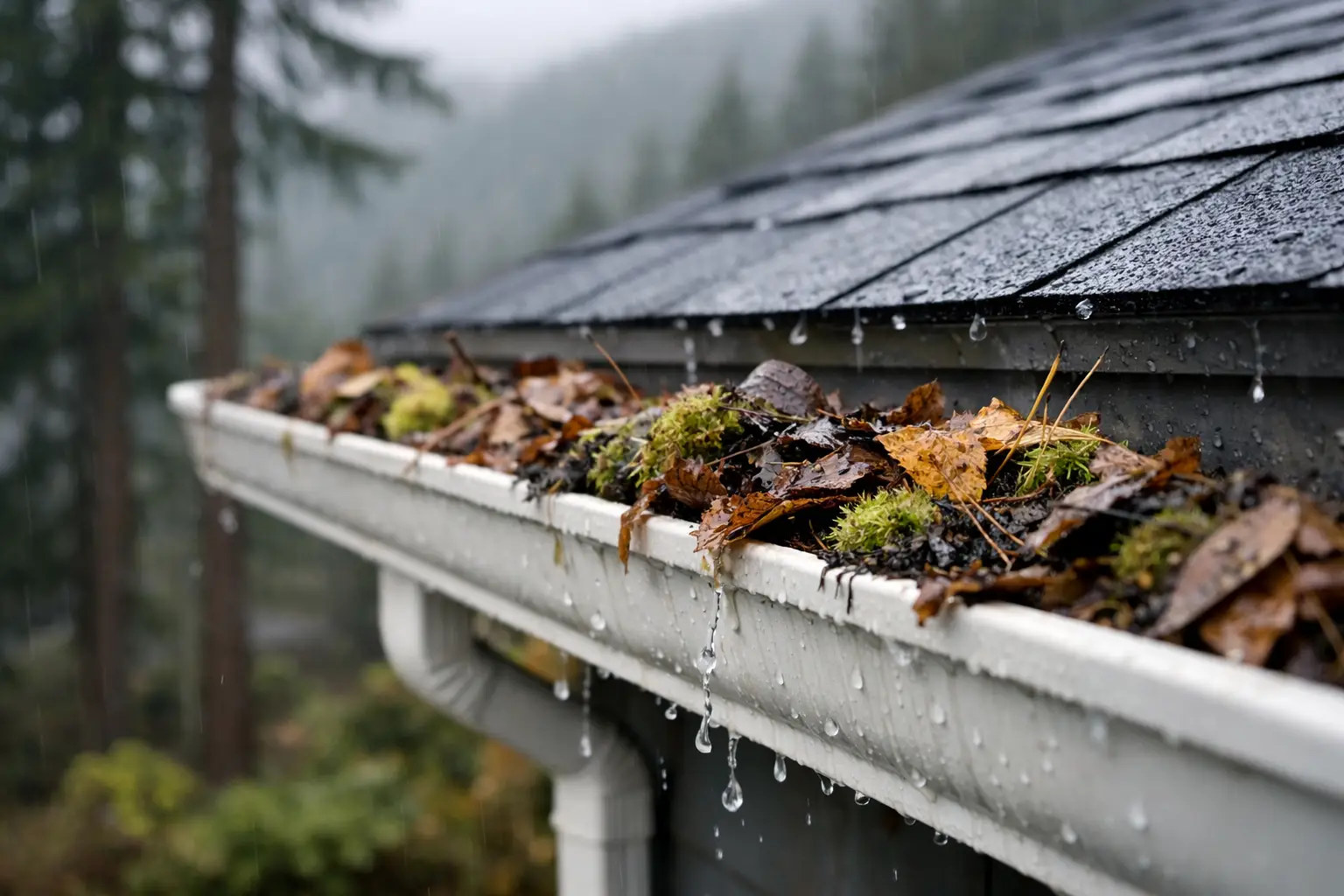
A clog is rarely caused by one big pile of leaves alone. More often, small materials collect in low spots, mix with water, and form a dense layer that slows drainage. Once that happens, the next storm pushes water over the gutter edge, behind the fascia, or down against the foundation.
Why Gutters Clog Quickly Around Portland and Vancouver
Pacific Northwest roofs and gutters work under conditions that are tougher than many standard gutter systems are designed to handle. Long wet seasons mean debris stays damp instead of drying out and blowing away. Damp debris sticks, breaks down, and compacts.
Evergreen trees are a major reason. Pine, fir, and cedar needles can fall for much of the year, not just during one autumn leaf drop. Their thin shape lets them settle in gutter channels and downspout openings, where they tangle with shingle grit and small twigs. A gutter may continue draining for a while, but the flow gets slower as that material builds up.
Roof runoff adds to the problem. Rainwater washes granules from aging asphalt shingles, especially after years of weather exposure. Those granules settle like sand in the bottom of the gutter. Mixed with decomposing organic debris, they create a heavy sludge that is difficult to rinse out naturally.
Rain Exposes Problems That Were Already There
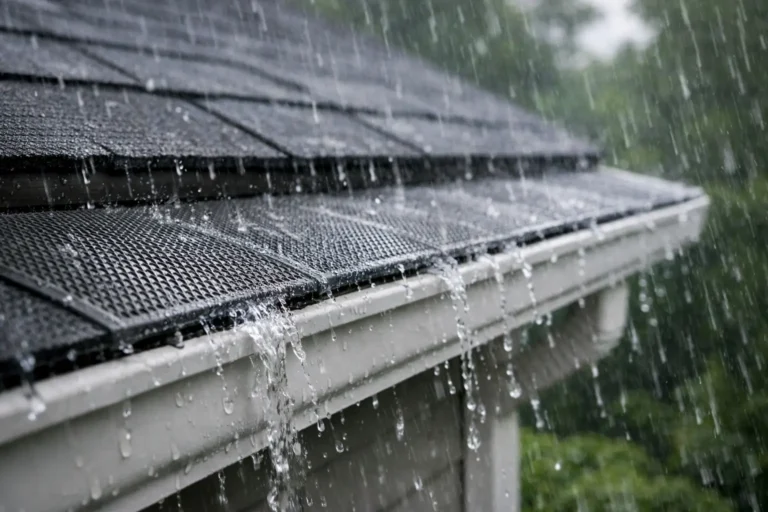
Heavy rain does not usually create the clog. It reveals it. A partially blocked outlet or downspout may handle a light drizzle without trouble, then fail during a sustained Northwest downpour.
This is why a homeowner may see water spilling over the front of the gutter only during the worst storms. The system had restricted capacity before the storm arrived. It simply did not have enough open space or enough drainage speed to manage the larger volume of roof runoff.
The Downspout Is Often the Real Bottleneck
When gutters overflow, many people assume the entire gutter trough is packed with debris. Sometimes it is, but the problem is often concentrated at the downspout outlet.
Water must make a sharp transition from the horizontal gutter into the downspout. Needles, leaves, seed pods, and roof grit tend to collect at that point. Once the outlet narrows, debris upstream begins to stack up behind it. What starts as a small restriction can turn into a full blockage quickly.
Undersized, poorly placed, or too-few downspouts can also contribute. Large or steep roofs move a surprising amount of water during a hard storm. If the gutter system does not have adequate drainage capacity, water can back up even when there is little visible debris. This is one reason gutter protection should be evaluated alongside gutter size, pitch, hanger support, and downspout layout rather than treated as a one-size-fits-all add-on.
Gutter Pitch and Installation Details Matter
A gutter should be installed with a subtle slope toward the downspouts. If it is too flat, water and sediment sit in place. If the slope is inconsistent, debris collects in the low areas and creates standing water. Over time, that wet material can support moss growth and add unnecessary weight to the gutter.
Loose gutters can make the issue worse. When hangers pull away from the fascia or spacing is inadequate, the gutter may sag under the weight of water and debris. The sag becomes a collection point, and a system that once drained reasonably well can begin clogging in the same location over and over.
Seams are another potential weak point. Traditional sectional gutters have joints that can catch debris and eventually leak. Custom-measured seamless aluminum gutters reduce the number of horizontal seams, which helps create a smoother path for water and reduces common buildup points. They still need proper installation, however. A seamless gutter is only as dependable as its pitch, fastening, outlet placement, and overall design.
Why Cleaning Alone May Not Solve Recurring Clogs
Regular cleaning is necessary for unprotected gutters, particularly beneath evergreen trees. But cleaning addresses the debris that is there today. It does not change how easily tomorrow’s needles, grit, and leaves enter the system.
For some homes, cleaning twice a year is enough. For properties near mature firs, pines, or heavily wooded areas, it may be needed more often. The trade-off is clear: frequent cleaning costs time, requires safe ladder work, and still leaves the home vulnerable between appointments.
A recurring clog in the same area is worth investigating instead of simply cleaning again. The cause may be a downspout restriction, poor gutter pitch, a sagging section, excess roof granules, or a tree branch that drops debris directly onto one roof valley. Correcting the underlying issue is more reliable than treating every overflow as a routine maintenance problem.
Do Gutter Guards Help With Pine Needles?
The right gutter guard can substantially reduce the debris entering the gutter, but not every guard performs the same way in the Pacific Northwest. Large-hole screens may keep out full-size leaves while allowing pine needles, small seeds, and roof grit into the channel. Reverse-curve designs can also be affected by heavy runoff, installation angle, and fine debris.
Fine stainless steel micro-mesh is often a better fit for homes dealing with pine and fir needles because it blocks smaller debris while allowing water to enter the gutter. The screen needs to be installed securely and at the correct angle so water flows through it instead of running past it during hard rain.
No guard makes a roof completely maintenance-free. Debris can still rest on top of the guard, especially beneath dense tree cover, and occasional inspection is sensible. The practical goal is to keep the gutter channel and downspout openings clear enough to drain properly, while greatly reducing the need for dangerous, repeated cleaning.
A Guard Cannot Fix a Failing Gutter System
Gutter protection is most effective when the existing system is sound. If gutters are pulling loose, leaking at seams, pitched incorrectly, or too small for the roof, adding guards alone will not correct those defects.
A professional assessment should look at the whole water-management path: roof edge, gutter size, hidden hanger strength, slope, downspouts, discharge location, and the type of debris around the home. That is especially important on homes with steep rooflines, long gutter runs, or concentrated valleys that send high volumes of water into one section.
Signs Your Clogs Are Becoming a Home Protection Issue
An occasional small overflow may not mean immediate damage, but repeated overflow should not be ignored. Water that runs behind gutters can affect fascia boards and soffits. Water that lands near the foundation can saturate soil, splash onto siding, and contribute to moisture problems around the home.
Watch for water spilling over the gutter lip, staining on siding, peeling paint near the roofline, sagging gutters, plant growth in the trough, or downspouts that barely discharge during rain. These signs point to restricted drainage or an installation issue that deserves attention before the next wet season.
If you are tired of cleaning the same debris out of your gutters, the best next step is not guessing at a product from the ground. Have the gutter system, tree cover, roof runoff, and drainage layout evaluated together. NW Gutter Protection helps local homeowners choose practical solutions built for the rain, roof grit, and evergreen debris that make Pacific Northwest gutter problems so persistent.
A clear gutter is not just about avoiding a messy overflow. It is about directing water where it belongs, storm after storm, so your roofline, siding, and foundation are not carrying the cost of a small blockage.