
Your Guide to Gutter Drainage Planning at Home
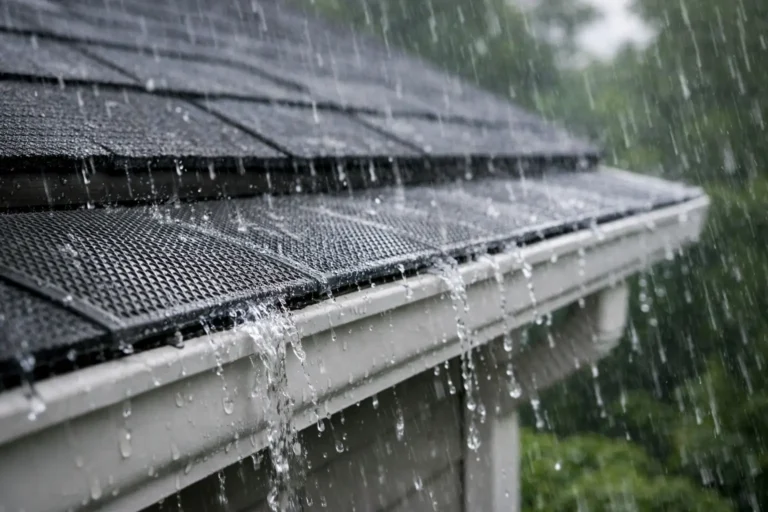
Water spilling over a gutter during a Portland or Southwest Washington downpour is not just a gutter problem. It is a drainage problem that can affect your siding, foundation, landscaping, and walkways. This guide to gutter drainage planning explains how the parts of the system need to work together so rainwater has a controlled path off the roof and away from the house.
Start With Where the Water Goes
Most homeowners first notice drainage issues at the roofline: a waterfall over the gutter, a downspout that backs up, or dark staining on the siding. The more costly trouble often starts at ground level. When a downspout empties beside the foundation, the soil becomes saturated, mulch washes away, and water can work toward crawl spaces, basements, or slab edges.
A good drainage plan follows the water from the highest point of the roof to its final discharge location. That means looking at roof valleys, gutter runs, downspout locations, extensions or underground drains, the yard slope, and any existing stormwater system. A gutter can be clean and properly installed yet still perform poorly if the downspout has nowhere effective to send the water.
In the Pacific Northwest, this matters because rain often arrives over long stretches rather than in a single short storm. Saturated ground cannot absorb unlimited runoff. A plan that seems adequate during a light fall shower may fail during a week of winter rain.
Size Gutters and Downspouts for the Roof, Not Just the Eaves
Gutters are not one-size-fits-all. Their capacity should match the roof area feeding each section, the roof pitch, and the way water concentrates at valleys. A long, steep roof plane can send a surprising amount of water into one short gutter run. A valley compounds the issue by directing runoff from two roof sections to one location.
For many homes, 5-inch seamless aluminum gutters are appropriate. Larger roof areas, steep pitches, long runs, or valley-heavy designs may call for 6-inch gutters and larger downspouts. The right answer depends on the home. Installing an oversized gutter everywhere is not always necessary, but undersizing a high-volume section creates predictable overflow when rain is at its heaviest.
Downspout capacity deserves the same attention. A gutter only moves water to the outlet. If there are too few downspouts, or if they are too small for the amount of roof feeding them, water can rise faster than it drains. As a general planning rule, prioritize outlets near valleys and at the low end of long gutter runs. Avoid treating downspouts as an afterthought added only where they are easiest to place.
Watch the Corners and Low Points
Corners, inside miters, and outlets are common stress points because they handle concentrated flow. A well-planned system gives water a clear route instead of forcing it to make abrupt turns or travel too far along a nearly level gutter. Proper pitch matters too. Gutters need a subtle slope toward the downspout, enough to drain consistently without looking visibly crooked from the ground.
Plan Downspout Discharge Before Installation
The best location for a downspout is not always the closest corner. It needs to be practical for drainage, protect the foundation, and fit the appearance of the home. On some properties, a downspout can discharge onto a splash block and flow safely across a sloped lawn. On others, that same setup would send water onto a patio, toward a neighbor’s property, or straight back to the house.
The goal is to move water far enough away that it does not collect near the foundation. Extensions are often the straightforward answer, provided they do not create a trip hazard or block a walkway. A buried solid drain line can provide a cleaner result where surface extensions are impractical, but it must have a reliable outlet and enough slope to drain. A buried pipe that ends in already saturated soil can become a hidden backup point.
Before directing roof runoff underground, verify where it will go. Depending on the property and local requirements, the appropriate destination may be a properly designed dry well, a daylight outlet, or an approved stormwater connection. Do not tie roof drainage into a sanitary sewer. If a home has an existing underground system, inspect it rather than assuming it is open, correctly pitched, and still functional.
Account for Your Yard’s Grade and Hardscape
Gutter drainage planning continues beyond the downspout. Walk around the home during or just after a hard rain. Look for pooling near foundation walls, water crossing driveways, muddy planting beds, and erosion channels beneath downspout outlets. These visible signs tell you where the property is already struggling to manage water.
A yard that slopes away from the home gives downspout discharge a natural path. A flat lot, retaining wall, or paved patio may require more deliberate routing. In some cases, regrading a small area or adding a drainage swale does more for the home than adding another gutter accessory. The practical question is simple: once the water leaves the downspout, can it continue moving away without creating a new problem?
Be especially careful with discharge near stairs, driveways, and frequently used paths. Winter runoff can leave moss, standing water, or slick surfaces. Moving water away from the foundation is necessary, but it should not create a safety issue at the front door or garage.
Keep Debris From Reducing Drainage Capacity
In Vancouver, Camas, Ridgefield, and the Portland metro area, gutters often handle more than rainwater. Fir needles, pine needles, leaves, moss, roof grit, and small twigs can reduce flow quickly. An outlet clogged with debris can make a correctly sized gutter behave as if it is undersized.
Gutter guards can help preserve drainage capacity, but they are not a substitute for correct gutter sizing, solid hangers, proper pitch, and adequate downspouts. A guard should keep debris out while allowing water to enter the gutter efficiently. The material and installation method matter, particularly under evergreen trees where fine needles can defeat wide-hole screens or loosely fitted covers.
A stainless steel micro-mesh guard is designed to block fine debris while allowing rainwater through. Even with a quality guard, roof valleys, upper roof edges, and visible gutter lines should be checked periodically. Wind-driven debris can collect on top of any guard, and roof moss or shingle grit may need attention over time.
Build for Strength, Service, and Real Weather
Drainage planning is also a construction-quality issue. Gutters must be securely fastened to the fascia with durable hangers, especially when they are carrying standing water or wet debris. Weak fastening can allow the gutter to pull away, lose its pitch, or create gaps behind the gutter where water reaches the fascia board.
Seamless aluminum gutters reduce the number of joints along a run, which means fewer potential leak points than sectional systems. They should still be custom measured and installed with the roofline, drainage direction, and outlet placement in mind. The cleanest-looking installation is not worthwhile if it puts a downspout in the wrong place or ignores a valley that routinely overwhelms the system.
For homeowners who want a professional assessment, NW Gutter Protection evaluates the roofline, debris exposure, gutter capacity, and downspout routing as one working system. That approach is particularly useful when recurring overflow has continued after repeated gutter cleanings.
A Practical Gutter Drainage Planning Checklist
Before replacing gutters, adding guards, or installing underground extensions, make sure you can answer these questions:
- Which roof sections produce the most concentrated runoff, especially around valleys?
- Are gutter and downspout sizes appropriate for those roof sections?
- Does every gutter run have a clear slope to a properly placed outlet?
- Where does each downspout discharge, and does water continue away from the foundation?
- Are underground drains open, sloped, and connected to an approved outlet?
- Could heavy evergreen debris block water flow at the gutter, outlet, or pipe entrance?
If one answer is unclear, that is the place to investigate before the next prolonged storm. Water damage rarely starts with a dramatic failure. More often, it begins with repeated small overflows that homeowners learn to ignore until the soil, siding, or foundation area shows the cost.