How Hidden Hangers Improve Gutter Strength
A gutter can look straight from the ground and still be under-supported. That matters in Southwest Washington and the Portland metro, where long stretches of rain, saturated leaves, fir needles, and occasional snow put real weight on a gutter system. Understanding how hidden hangers improve strength helps homeowners look beyond gutter guards and aluminum thickness to the hardware holding the entire system to the house.
Hidden hangers are small, heavy-duty brackets installed inside the gutter. They are not visible from the curb, but they do a major share of the structural work. Properly placed and fastened into solid fascia, they help keep seamless gutters level, secure, and better prepared for Pacific Northwest weather.
What hidden hangers actually do
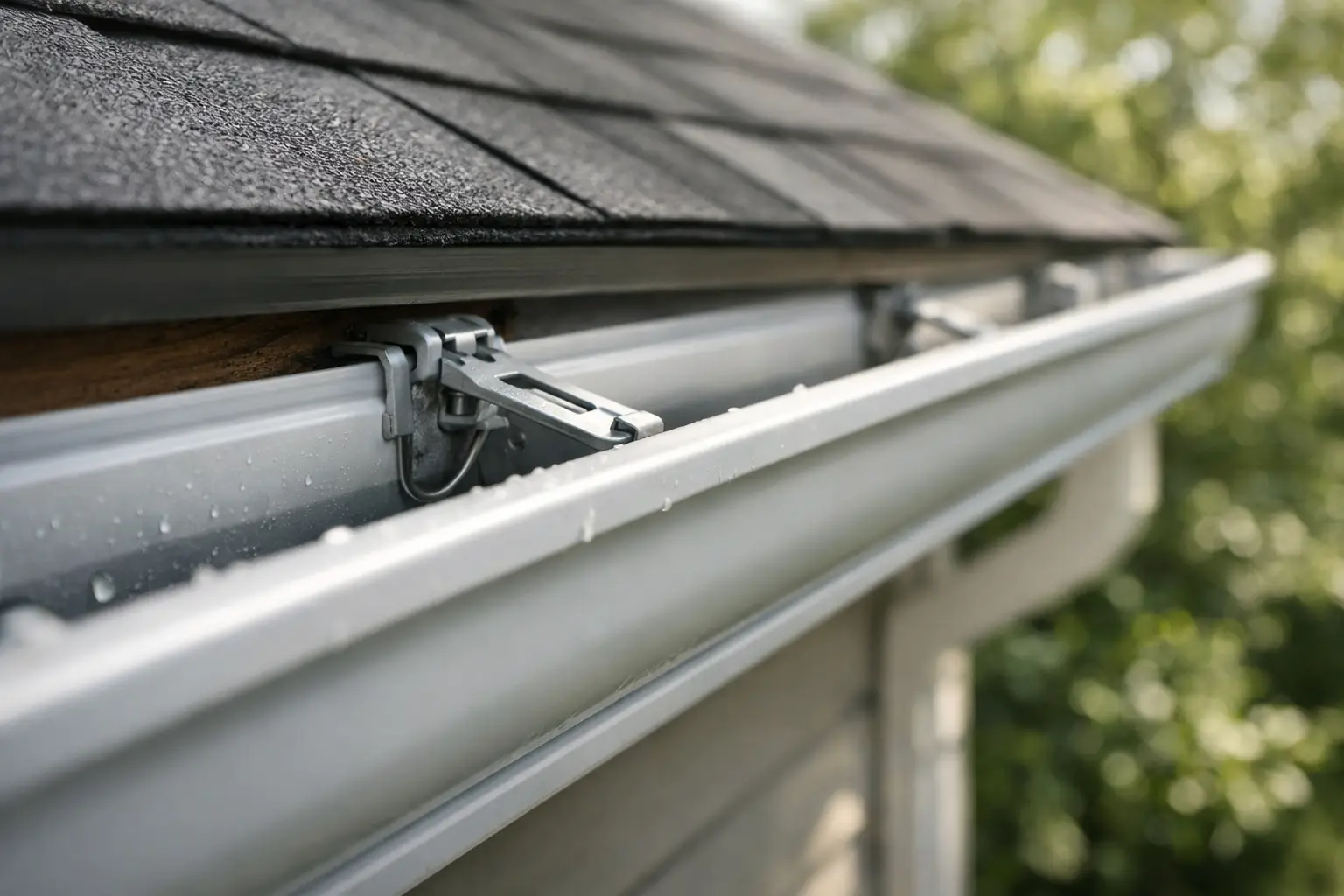
A hidden hanger bridges the back of the gutter to its front edge, reinforcing the gutter’s shape while anchoring it to the fascia board. Installers drive a long screw through the hanger and into the wood behind the gutter. Once installed, the hanger stays inside the trough, so it does not interrupt the clean exterior line of the gutter.
Older gutter systems often rely on spikes and ferrules, or on visible straps that can loosen over time. A spike runs through the gutter and into the fascia, but repeated movement, moisture, and load can gradually work it loose. When that happens, the gutter may begin to pull away from the roofline, sag between attachment points, or lose its intended slope toward the downspout.
Hidden hangers use a more secure attachment method. The screw creates a firm mechanical connection, and the bracket supports both the gutter’s back wall and front lip. The result is a stronger installation without exterior hardware showing on the face of the gutter.
How hidden hangers improve gutter strength in wet weather
The value of hidden hangers becomes clear when a gutter is carrying weight. Rainwater alone is heavy. Add wet maple leaves, cedar debris, shingle grit, or a pocket of frozen material, and a poorly supported gutter can flex or pull away from the fascia.
They spread the load along the gutter run
A gutter is not supported by one bracket. It is supported by a series of hangers installed along its length. Proper spacing distributes the load instead of allowing one section to bear too much weight. This reduces the chance of a visible dip forming in the middle of a long run.
That dip is more than a cosmetic problem. Standing water collects in low spots, adding more weight and creating a cycle of stress. Water that cannot move consistently toward the downspout can also overflow near entryways, landscaping, siding, and foundation areas.
They resist pull-out better than aging spikes
Long screws installed through hidden hangers generally hold more securely than the old spike-and-ferrule approach, especially when they are driven into sound fascia. The screw threads grip the wood, helping the gutter resist the outward and downward forces created by heavy water and debris.
This does not mean every hidden-hanger installation is automatically strong. The condition of the fascia is critical. If the board is soft, rotted, split, or poorly attached, even quality hardware has weak material to hold onto. A professional installer should identify damaged fascia before fastening a new gutter system over it.
They help preserve the gutter’s shape
Seamless aluminum gutters are made to carry water efficiently, but aluminum can deform if it is overloaded or inadequately supported. Hidden hangers reinforce the front edge and help the gutter maintain its profile. That support is especially useful on longer gutter runs, where even a small amount of deflection can affect drainage.
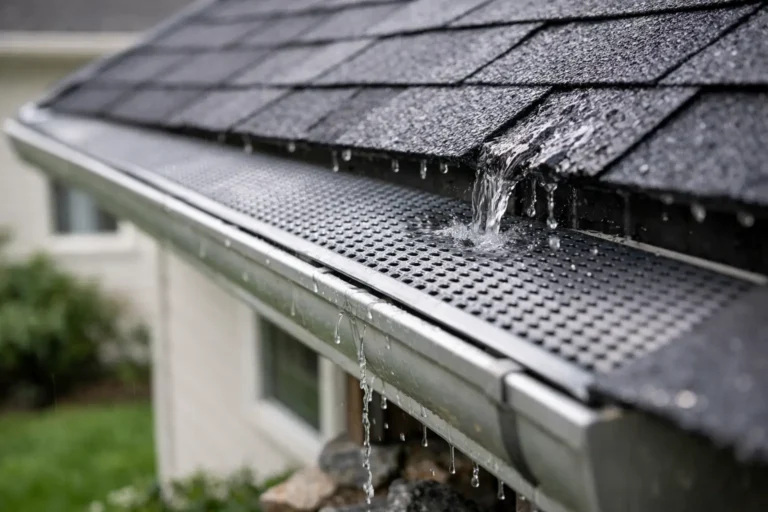
Keeping the gutter shape intact also helps gutter guards fit and perform as intended. Micro-mesh gutter guards need a stable gutter edge and proper attachment points. If the gutter is sagging or pulling away from the fascia, guard performance and water flow can suffer along with it.
Why spacing and fastening matter as much as the hanger
Homeowners sometimes hear that a company uses hidden hangers and assume the installation details are settled. The hanger itself is only part of the equation. Strength depends on the hanger material, the screw length and quality, the spacing between hangers, the fascia condition, and the installer’s ability to maintain the correct gutter pitch.
In the Pacific Northwest, closer spacing can make practical sense because gutters routinely hold wet organic debris between cleanings or during heavy storms. The right spacing depends on the gutter size, roof layout, expected water volume, and local conditions. A simple one-size-fits-all layout is not always the right answer for a steep roof under tall evergreens.
Fastening location matters, too. Screws need to penetrate solid wood, not just thin trim or deteriorated fascia. If a roof has hidden rot from long-term overflow, that issue should be addressed before new gutters are installed. Covering a failing board with new hardware may make the system look finished for a while, but it does not create a dependable attachment.
Hidden hangers and seamless gutters work well together
Custom-measured seamless gutters are formed to fit each home, which reduces the number of joints along a gutter run. Fewer seams mean fewer locations where leaks can develop over time. Hidden hangers complement that design by providing consistent support across the continuous length of the gutter.
The combination matters on homes with broad roof planes or long eaves. A continuous gutter needs consistent support from end to end so water keeps moving toward properly sized downspouts. If the system is loosely attached, even a well-made gutter can lose its slope and begin holding water.
A clean finished appearance is another benefit. Because hidden hangers sit inside the gutter, the outside face remains uncluttered. For homeowners replacing bent, stained, or spike-punctured gutters, this creates a more finished look without sacrificing structural support.
What hidden hangers cannot fix
Hidden hangers are strong hardware, not a cure for every drainage problem. They will not correct undersized gutters, too few downspouts, poor roof drainage design, damaged fascia, or a gutter system installed at the wrong pitch. They also cannot stop debris buildup on their own.
That is why the whole system should be considered together. A home surrounded by Douglas firs may benefit from a gutter guard designed to shed needles while allowing water through. A large roof valley may require special attention to water volume and downspout placement. A home with recurring overflow at one corner may have a pitch or capacity issue rather than a hanger issue.
The best installation matches hardware to the home rather than treating every roofline the same. For many properties in Vancouver, Camas, Ridgefield, Portland, and nearby communities, that means custom seamless gutters, securely fastened hidden hangers, correctly placed downspouts, and gutter protection suited to local debris.
Signs your gutters may need stronger support
Look along the gutter line from several angles. A sagging section, a gap between the gutter and fascia, loose spikes, visible standing water after rain, or recurring overflow in one area can all point to support problems. Peeling paint or water stains behind the gutter may also indicate that water has been escaping where it should not.
Do not assume the gutter is the only issue. A careful inspection should include the fascia, roof edge, downspouts, and the flow path around the home. Reattaching a loose gutter to damaged wood can delay the real repair rather than solve it.
A stronger gutter system starts behind the front edge
The hardware inside a gutter is easy to overlook because it is designed to stay out of sight. Yet hidden hangers are one of the details that separate a gutter system that merely looks new from one built to carry years of Pacific Northwest rain and debris. When gutters are custom-fit, securely fastened to sound fascia, and designed for the home’s water load, homeowners get more than a cleaner roofline. They get a system that is far more likely to stay where it belongs when the weather turns.