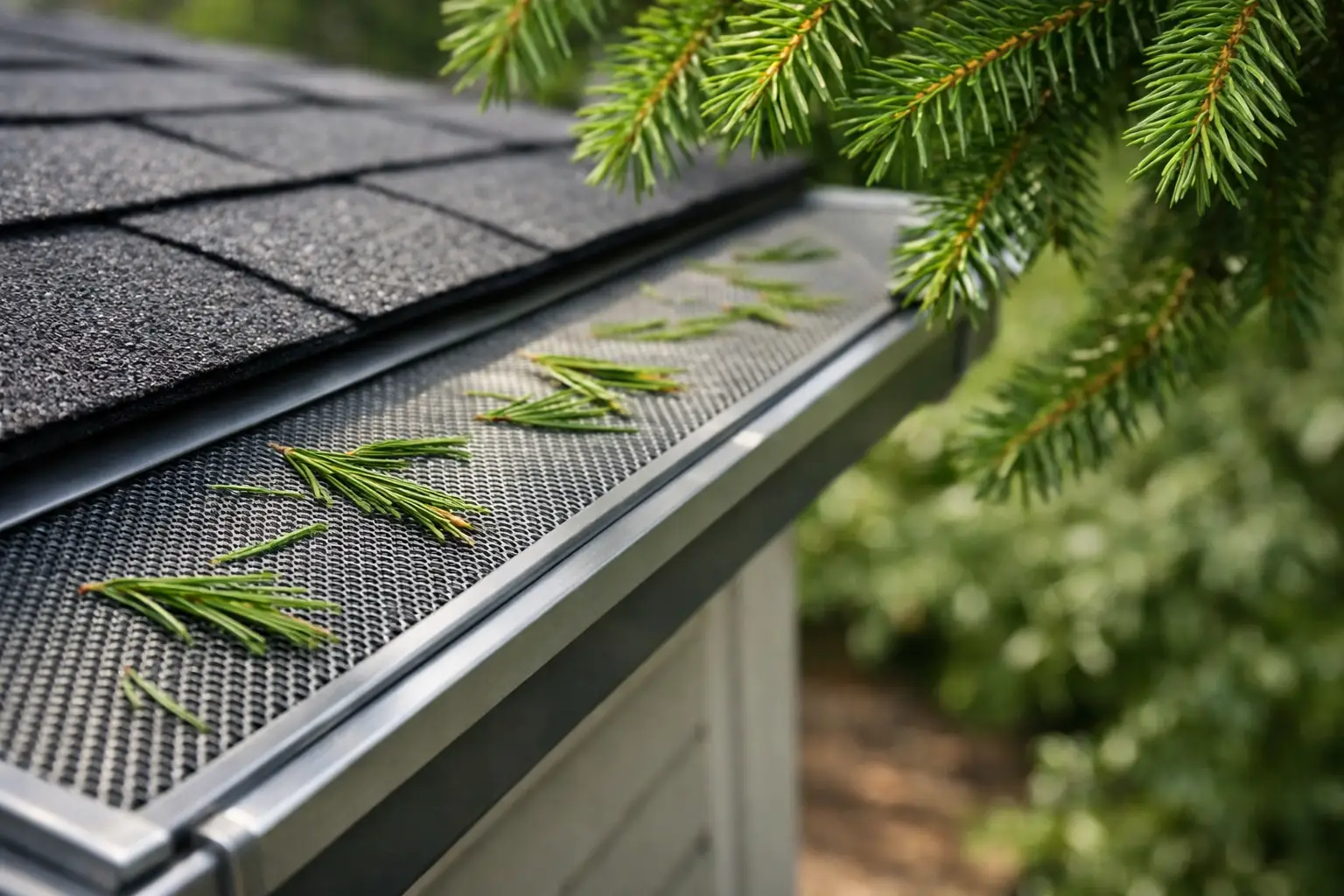
Best Gutter Guards for Fir Needles
If you live under Douglas firs, you already know this is not the same cleanup problem people deal with in maple or oak country. Fir needles are narrow, stubborn, and constant. They land in gutters, slide into seams, bunch at valleys, and turn every rainy week into a test of whether your system can still move water. That is why choosing gutter guards for fir needles takes more than picking whatever is cheapest at the home store.
In the Pacific Northwest, the question is not whether debris will hit your gutters. It is whether your guard system can keep shedding fine evergreen material while handling long periods of rain. A guard that looks fine in a dry climate can become a maintenance problem fast when needles, roof grit, and heavy runoff all show up at once.
Why fir needles are hard on gutter systems
Fir needles create a different kind of clog than broad leaves. Leaves usually pile up on top or collect in large clumps you can scoop out. Needles are lighter, smaller, and easier for wind and water to move around. They can bridge across openings, settle into small slots, or wash into the gutter in thin layers that build up over time.
They also rarely arrive alone. On many Pacific Northwest homes, gutters are dealing with fir needles, pine needles, asphalt shingle grit, moss fragments, and seed debris in the same season. That mix matters. Even if a guard can stop larger material, it may still let enough fine debris through to create a muddy sludge inside the gutter.
Once that happens, water flow slows down. Overflow starts at the front edge or behind the gutter, and fascia boards, soffits, siding, and foundations can all end up paying the price.
What kind of gutter guards for fir needles actually work?
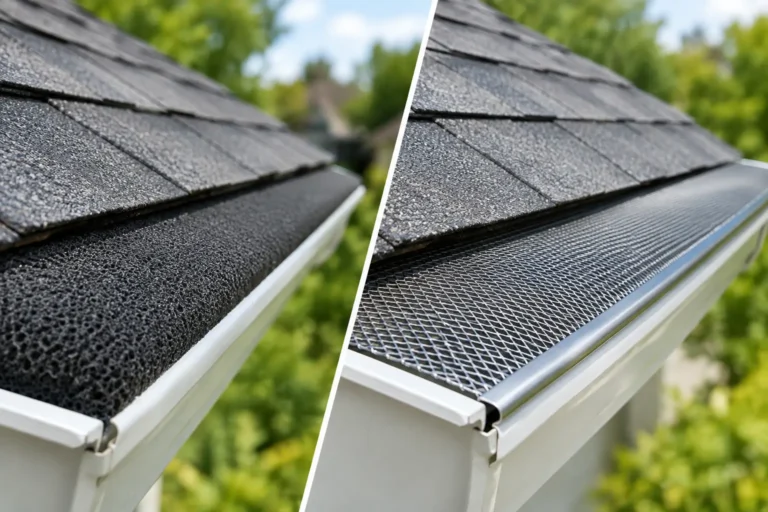
For most homes surrounded by evergreens, the best-performing option is a stainless steel micro-mesh system installed over a properly pitched gutter. The reason is simple. Micro-mesh is designed to block fine debris while still allowing water to enter across a broad surface area. When the mesh opening is small enough and the frame is strong enough, fir needles are more likely to wash or blow off the top instead of filtering into the trough.
That does not mean every mesh guard performs the same. Material quality, mesh design, frame rigidity, and installation method all affect how well the system handles real roof conditions. A flimsy insert can sag. A poorly fitted panel can leave gaps at the edges. A guard installed over an undersized or badly pitched gutter will still struggle, no matter how good the screen is.
This is where homeowners sometimes get disappointed. They buy the idea of gutter protection, but what they actually needed was a complete system that accounts for runoff volume, roofline layout, hanger strength, and the kind of debris their property sees every week.
Gutter guards for fir needles: designs that usually fall short
Some guard styles sound good on paper but do not hold up well under evergreen debris.
Brush and foam inserts
Brush inserts and foam products are usually the fastest to install, and that is part of the problem. They sit inside the gutter instead of becoming part of a more complete protection system. Fir needles can lodge in the bristles or settle on top of foam, where they trap moisture and organic debris. Over time, that can create a damp mat rather than a clean water path.
They also tend to age poorly in wet climates. Once debris begins collecting in the insert itself, cleaning becomes less convenient than people expect.
Large-hole screens
Basic screens with bigger openings can stop leaves, but fir needles are another story. Fine needles and roof granules can pass through, especially during heavy rain. You may reduce the frequency of cleanings, but you do not eliminate the root issue.
For a homeowner dealing with dense fir coverage, that can turn into a half-solution that still requires regular service.
Reverse curve or surface-tension systems
These systems are meant to pull water around a curved edge while debris falls away. They can work in some settings, but they are more sensitive to installation details, roof pitch, runoff speed, and debris type. Fine needles can cling to the leading edge or collect around openings, especially where heavy rain and evergreen debris hit at the same time.
They also tend to be more visible from the ground, which some homeowners do not like.
Why professional installation matters as much as the product
A lot of gutter guard failures get blamed on the guard when the real problem is installation. If the panels are not custom fit to the roofline, if the fasteners are weak, or if the gutter itself is loose or improperly sloped, performance drops quickly.
On homes in Southwest Washington and the Portland metro, installation quality matters even more because of rain intensity and seasonal debris volume. Gutters need enough pitch to move water without pooling. Hangers need to support the load during wet winter conditions. Guard panels need to sit securely and consistently so water enters where it should and debris does not slip around the edges.
That is one reason many homeowners do better with a contractor who understands Pacific Northwest conditions instead of a one-size-fits-all product pitch. The right guard on the wrong system is still the wrong solution.
How to tell if your home needs more than just guards
Sometimes the conversation starts with fir needles, but the bigger issue is the gutter system underneath. If your gutters are pulling away from the fascia, overflowing at corners, leaking at seams, or undersized for the roof area, adding guards alone may not solve much.
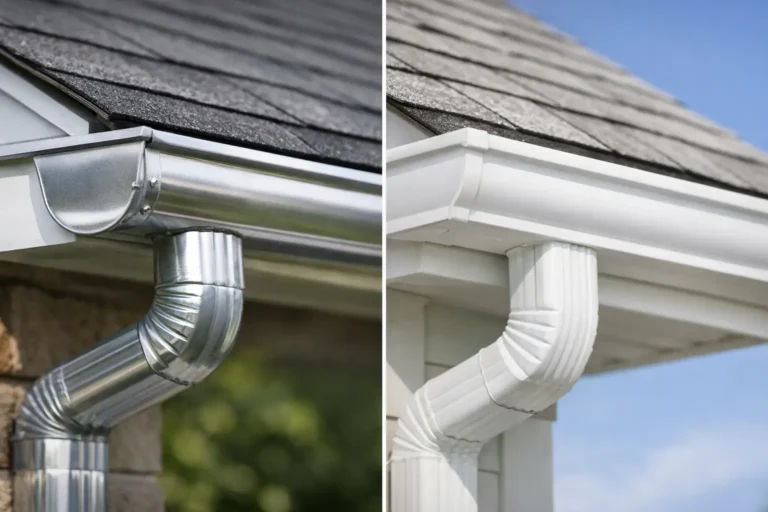
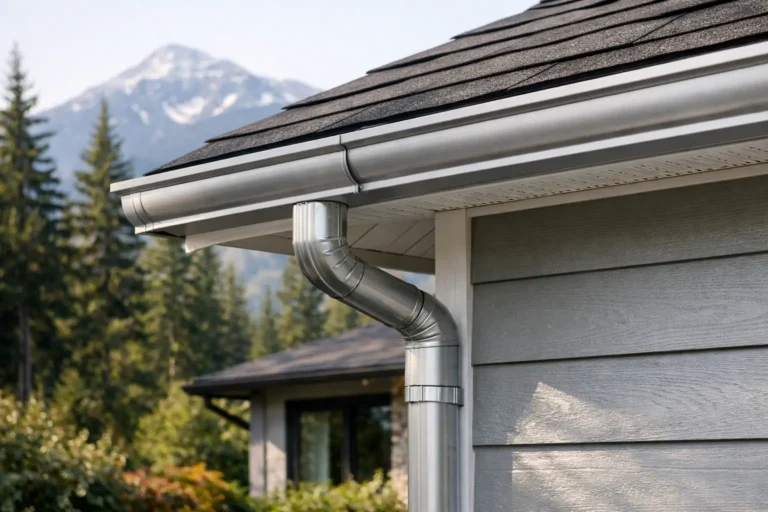
Seamless aluminum gutters are often the better foundation because they reduce leak points and can be custom measured to the house. Paired with hidden hangers and a high-quality micro-mesh guard, they create a much stronger system than trying to cover an aging gutter that already has structural or drainage issues.
That is especially true on older homes with long runs, multiple roof planes, or heavy water concentration at valleys.
What homeowners should ask before buying gutter guards for fir needles
You do not need a long sales presentation. You need straight answers.
Ask what debris the system is specifically designed to handle. Ask whether the mesh is stainless steel or a lower-grade material. Ask how the installer handles roof valleys, corners, and transitions. Ask whether the existing gutters will be inspected for pitch, attachment, and capacity before any guards go on.
You should also ask about warranty coverage and who stands behind the installation. A product warranty matters, but workmanship matters too. If there is ever a problem, homeowners want to know who is accountable and whether they can reach a real local company.
That no-nonsense approach is one reason homeowners across this region often prefer owner-led companies like NW Gutter Protection. The work is more specific to local conditions, and the recommendation is usually based on what your house needs, not on pushing a product that happens to be in stock.
What to realistically expect after installation
Good gutter guards reduce maintenance. They do not mean your gutter system will never need attention again.
On a fir-heavy property, you may still see needles resting on top of the guard from time to time. That is normal. The goal is not to make debris disappear. The goal is to keep water flowing and prevent the kind of internal buildup that causes clogs, overflow, and damage.
In many cases, occasional visual checks and light surface clearing are all that is needed. That is a very different situation from climbing a ladder several times a year to dig packed needles out of wet gutters by hand.
The better the fit, material quality, and underlying gutter design, the less maintenance most homeowners will deal with over the long run.
The right choice depends on your trees, roof, and runoff
There is no single answer that fits every house. A one-story ranch with moderate tree cover is different from a steep-roof home under dense evergreen canopy. Roof material matters. Water volume matters. So does the condition of the current gutter system.
But for homes dealing with regular fir needle buildup, the general pattern is clear. Fine-debris protection requires a high-quality micro-mesh design, durable materials, and installation that is tailored to the house. Anything less usually turns into a compromise.
When gutters are expected to perform through months of rain, shortcuts do not stay hidden for long. A well-built system does not just cut down on cleaning. It protects the parts of your home that water reaches next.
If your gutters are losing the battle every winter, the fix should be practical and built for where you live. Fir needles are not going away, but the constant clogging can.