Residential Gutter Slope Guide for Wet Climates
Water should not sit in a gutter after a Portland rainstorm. If it does, the issue may be more than leaves or a clogged downspout. This residential gutter slope guide explains how gutter pitch works, what a properly installed system should look like, and when standing water points to a repair worth addressing before the next long stretch of Pacific Northwest rain.
What gutter slope does for your home
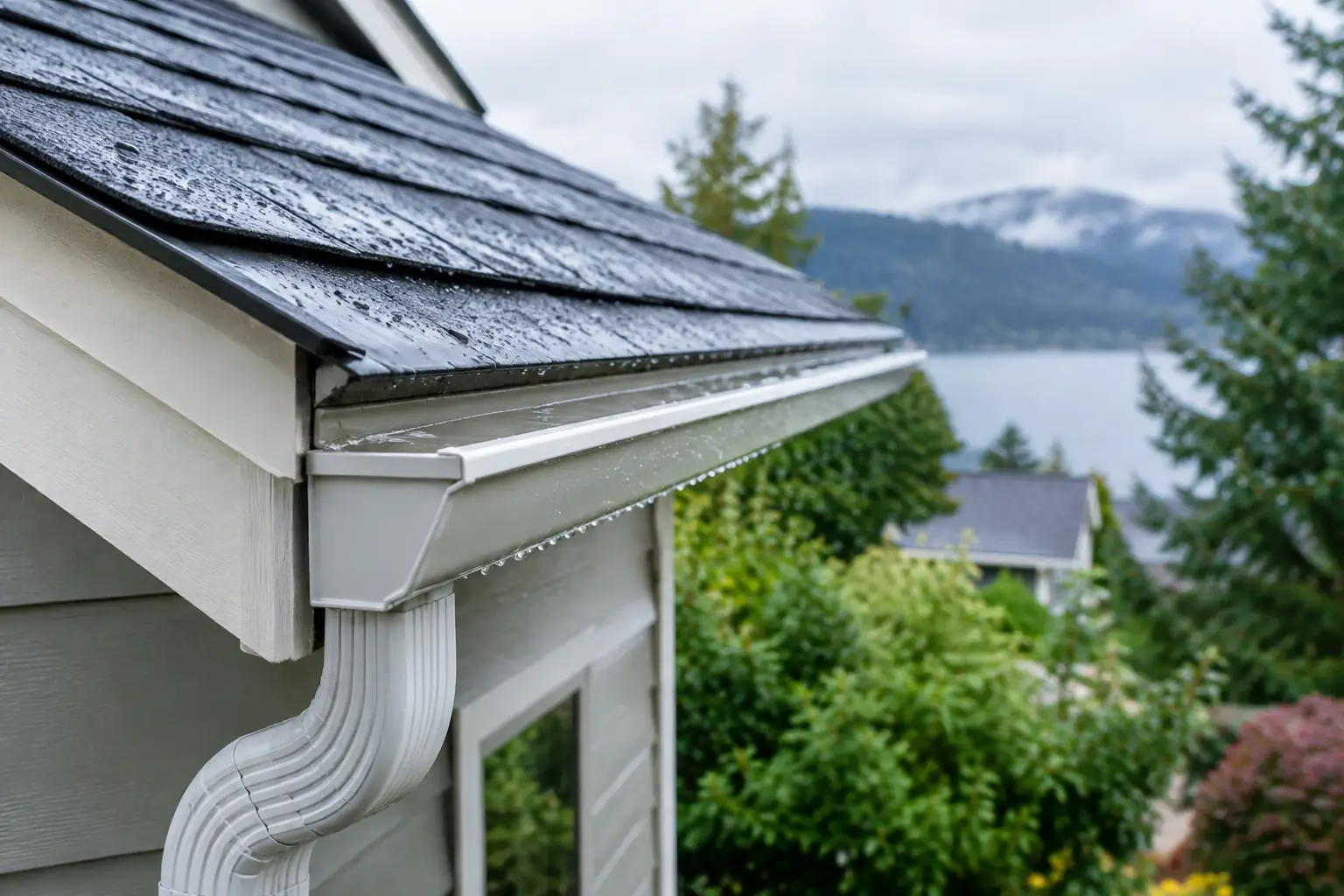
Gutter slope, also called pitch, is the slight downward angle that moves water from the high end of a gutter run toward the downspout. The angle is subtle enough that it should not look noticeably crooked from the ground, but it must be precise enough to keep water moving.
Without adequate slope, rainwater slows down and settles along the bottom of the gutter. That standing water collects roof grit, shingle granules, moss, and organic debris. Over time, the material can form a heavy sludge that restricts drainage, holds moisture against the gutter, and adds unnecessary weight to the fascia board.
In Southwest Washington and the Portland metro area, this matters more than it might in a dry climate. Our roofs see frequent rain, long wet seasons, pine and fir needles, and wind-driven debris. A gutter that drains only marginally can become a gutter that overflows when the weather turns serious.
The standard residential gutter slope
For most residential gutter runs, a common installation target is about 1/16 inch of fall for every foot of gutter length. In plain terms, a 20-foot gutter run would drop about 1 1/4 inches from its high point to the downspout outlet.
Some installers use closer to 1/8 inch per foot when a roof collects a large volume of water or when the run is especially long. More pitch improves water movement, but there is a practical limit. Too much visible slope can look uneven along the roofline, and an excessive drop at one end may affect the gutter’s appearance or fit beneath the drip edge.
The right slope depends on the length of the run, the roof area feeding it, the gutter size, and the number and placement of downspouts. A simple 12-foot run serving a small porch roof is not engineered the same way as a 40-foot run below a steep main roof.
Long gutter runs may need a center high point
On a long section of gutter, water does not always need to travel to one end. A professional installer may set a high point near the middle and slope the gutter in both directions toward downspouts at each end. This reduces the distance water has to travel and helps prevent water from backing up during heavy rainfall.
This approach is especially useful on wide front elevations and long garage rooflines. It also helps preserve a cleaner visual line than forcing a dramatic drop across the entire span.
Downspout capacity matters as much as pitch
Slope cannot make up for undersized or poorly located downspouts. If a large roof area funnels into one short gutter run with a single downspout, water may still overflow during a hard downpour even when the gutter is pitched correctly.
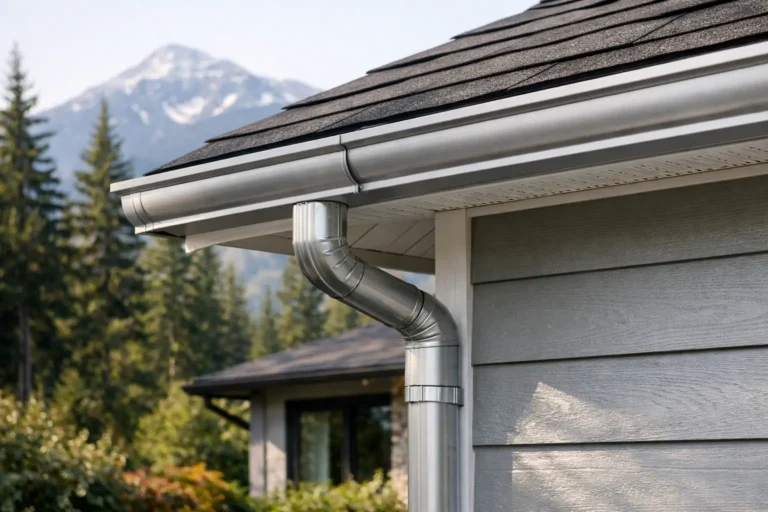
A complete drainage plan considers gutter dimensions, outlet size, downspout placement, roof valleys, and where discharged water goes once it reaches the ground. Water should move away from the foundation through properly placed extensions or a suitable drainage system, not pool beside the house.
How to tell if your gutters have a slope problem
Standing water is the clearest sign, but it is not the only one. After the rain stops, a small amount of moisture may remain around seams or debris, especially on older systems. A visible line of water that stays in the bottom of a clean gutter for hours, however, deserves attention.
Look for recurring overflow in the middle of a run, even after cleaning the downspout. Notice whether one section holds dark, muddy debris while the rest of the gutter is relatively clean. Watch for water spilling behind the gutter, staining the fascia, or dripping from locations that are not near a downspout.
You may also see fastener problems. Water and wet debris are heavy. When they remain in one section, gutters can pull away from the fascia or develop a low spot between hangers. That low spot catches even more water, creating a cycle that gets worse over time.
From the ground, inspect the gutter line from several angles. The slope should be subtle, but the gutter should not sag, wave, or dip noticeably. If a straight run looks uneven, the problem may be loose hangers, fascia damage, an incorrectly pitched installation, or a combination of all three.
Why gutters lose their pitch
Not every slope issue begins with a poor installation. Homes move, wood fascia ages, and fasteners can loosen after years of carrying wet debris. Ice is less common here than in colder regions, but winter storms, wind, and saturated gutter troughs can still stress the system.
The most common causes include inadequate hanger spacing, bent or damaged gutters, failing fascia boards, and heavy debris buildup. Older sectional gutters are also more prone to problems at seams, where leaks and trapped debris can accelerate wear.
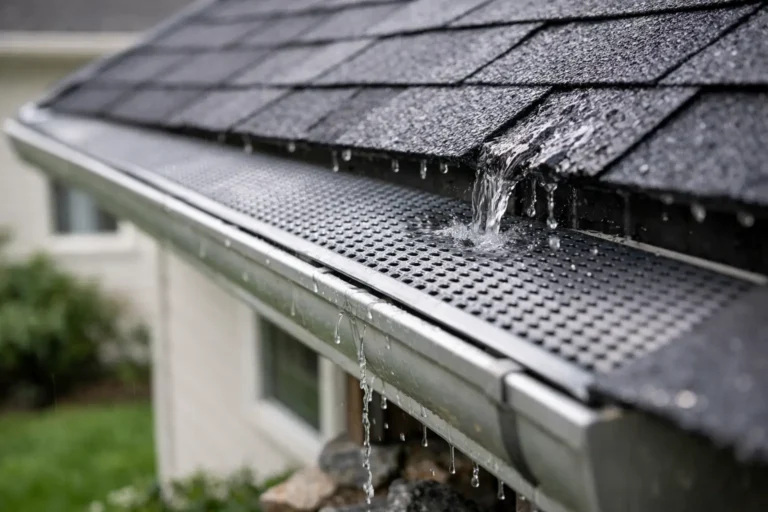
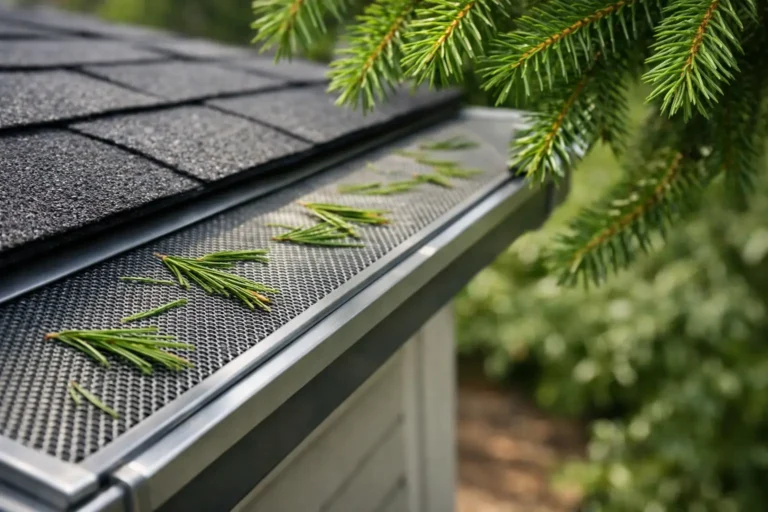
Gutter guards can help reduce the debris load, but they do not correct an existing pitch problem. A quality micro-mesh guard keeps pine needles, fir needles, roof grit, and leaves out of the trough while allowing water to enter. The gutter underneath still needs the correct slope, secure attachment, and adequate downspout capacity to perform as intended.
Can you check gutter slope yourself?
Homeowners can make a basic assessment from a ladder, but there is a difference between spotting a concern and diagnosing the full system. Ladder work around wet roofs, uneven landscaping, and overhead lines carries real risk. If you are not comfortable working at height, do not force it.
For a simple visual check, wait until the gutter is clear of debris and use a level along the gutter bottom where accessible. A short level may not show the full fall across a long run, so measurements are more useful when taken at several points. Measure from a consistent reference point, such as the roof edge or a stretched string line, rather than assuming the fascia itself is perfectly level.
A water test can also reveal a problem. With the downspout confirmed open, run a moderate stream from a hose into the high end of the gutter. Water should travel steadily to the outlet without collecting in the middle. Avoid blasting water at full pressure, which can create a result that does not reflect normal rainfall.
If water slows at one specific location, mark it. That spot may be a local sag rather than an overall pitch issue. If the entire run drains poorly, the installation layout may need to be reset.
When a gutter needs adjustment instead of replacement
A sound seamless aluminum gutter system can often be re-pitched if the metal is in good condition and the fascia remains solid. The installer removes or loosens the existing hangers, establishes the correct high and low points, resets the gutter, and secures it with properly spaced hidden hangers.
Replacement becomes the better choice when the gutter is badly bent, repeatedly leaking at seams, undersized for the roof, or attached to rotten fascia. It may also make sense when the current downspout layout is inadequate. Re-pitching a system that cannot handle the roof’s water volume only treats part of the problem.
For homeowners already dealing with frequent cleaning, replacement can be the time to address slope, gutter size, downspouts, and debris protection together. NW Gutter Protection approaches these details as one working system because a premium guard cannot compensate for a gutter that is loose, undersized, or draining in the wrong direction.
Installation details that protect proper pitch
A reliable installation starts with measuring the roofline and identifying where water naturally concentrates. Valleys, steep roof sections, and broad roof planes deserve special attention. The gutter is then set beneath the drip edge where appropriate, pitched toward properly placed outlets, and fastened into solid fascia with enough hanger support to resist the weight of water and debris.
The exact hanger spacing depends on the gutter system, fascia condition, and site conditions, but the goal is consistent: no weak spans that can sag after a wet winter. Downspouts should be securely attached, sized for the drainage demand, and directed away from the foundation.
A straight-looking gutter is not automatically a correctly installed gutter. The best work balances appearance with the small, deliberate pitch that keeps water moving. That is the kind of detail homeowners rarely notice on a dry day but appreciate during the next heavy storm.
If you see standing water, recurring overflow, or a sagging gutter line, address it while the repair is still straightforward. A properly pitched gutter does quiet work every time it rains: it keeps water off the fascia, away from the foundation, and moving where it belongs.